
By Evan Ney, Writing Assistant, College of Arts and Sciences
Data can help unlock solutions to many of a community’s most pressing issues. But many times, a community organization lacks the resources to use the data that is so readily available to them. To make sure their data wasn’t going to waste, the Lane Workforce Partnership, tasked with helping low-income residents find better employment, turned to a team of four students at the University of Oregon who were motivated to use their skills and knowledge to impact the community.
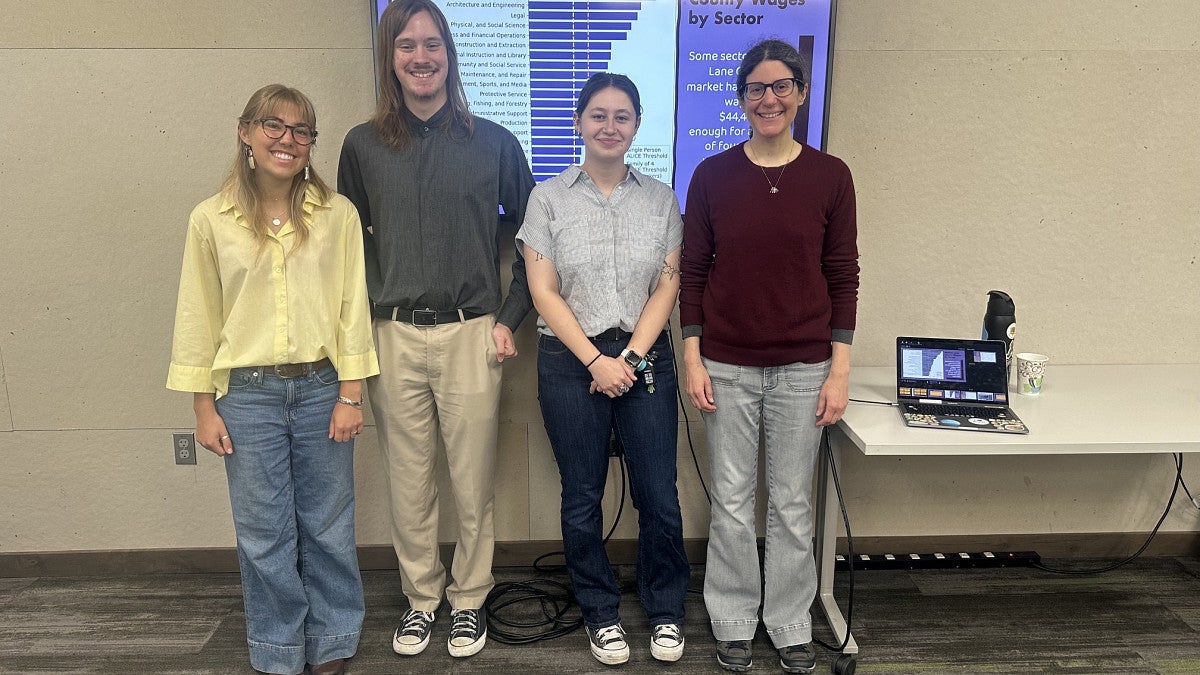
The data analysis project originated in the Local Solutions Studio Class, a course in the School of Planning, Public Policy and Management (PPPM) that serves as a final academic project. Jennifer Linnaea ’26 and Tara Disser ’26, data science majors in the School of Computer and Data Sciences (SCDS) in the College of Arts and Sciences, joined forces with Robert Baker ’27 and Ayla Windley ’26, PPPM majors, to analyze data from the Lane Workforce Partnership. Their goal was to provide recommendations that would support workers living under the Asset Limited, Income Constrained, Employed (ALICE) threshold.
Addressing income inequality in Lane County
ALICE refers to households that earn more than the federal poverty level, but not enough to afford the basics where they live. According to the organization United for ALICE, in 2024, 42% of households in Lane County were living under these precarious conditions.
“Our task was to determine what jobs fall below the ALICE threshold, and how we can help people working them push past it without requiring them to go back to school and get a whole degree,” said Disser.
The analysis team worked with publicly available employment data that Partnership workers had begun exploring but hadn’t had the chance to analyze fully. Disser and Linnaea spent a term pulling it apart to gather trends and make recommendations, while Baker and Windley conducted interviews to gather anecdotal data from community members.
“One of our takeaways was that many of the jobs we identified were just fundamental jobs for our community,” said Linnaea. “So on the one hand, we want to get people out of these jobs, but on the other hand, the fact of the matter is that people are going to end up in these jobs because they’re foundational.”
Ryan Kounovsky, director of workforce strategy and partnership for the Partnership, was a primary contact for the students. He said the Partnership had been doing a lot of thinking about economic mobility in Lane County, and especially how wages, education and career pathways line up with what it actually costs people and families to live in the community. They had a lot of data and some big questions they wanted to explore but not necessarily the capacity to dig into all of them on their own. The students gave the Partnership an opportunity to do that.
“They brought fresh eyes to the work. They asked critical questions, made deeper connections with local partners, and dug into pieces of the data that helped us think differently about some of the assumptions we make in workforce development,” Kounovsky said. “That is really valuable for a small organization like ours because it gives us additional capacity, but also a different perspective than we would get just looking at the same questions internally.”
Connecting communities with solutions
After combining their data analysis with information gleaned from interviews conducted by Baker and Windley, the project culminated in a paper and a half-hour presentation to the Lane Workforce Partnership and a group of community partners.
“The best part of the presentation was that afterwards they had some questions for us, but mostly people started talking amongst themselves about the topic. Some people mentioned to us that this was the first time in a while that so many representatives from around Lane County had actually gotten in a room together, so it was exciting to bring people together to help spark that conversation,” said Disser.
Collaborative projects like this are a way for students to get real experience before graduating while also building relationships among community organizations. The interdisciplinary team — PPPM and SCDS — also allowed the team members to build new skills as they learned from each other. While the project benefits the students, in the end, the Partnership has information they can use to benefit the community.
“It will take a lot of effort from a lot of people across the community to start addressing this issue, but the data helps point us in the right direction,” Linnaea added. “It was meaningful to take what we had been learning in data science classes for so many years, and to do something helpful to the community with it.”
Moving forward with data and service
The project ended up as an important starting point for the Partnership, but also for Linnaea and Disser’s career paths. Linnaea was accepted into a PPPM master’s program where her goal is to combine her data science skills with service to the community, and Disser is finishing up an internship while searching for a community-oriented job. Baker has another year of school and Windley also just graduated.
“This was the first project that I had gotten to work on that felt tangible to me,” said Disser. “It wasn’t like I had just found this dataset somewhere and was doing something random with it. Someone came and asked us to see what we could come up with to solve a real issue.”
While solving the problem of income inequality in Oregon is far beyond the scope of the students’ work in a single term, classes like this can serve as an important launchpad into the real world.
“What I really appreciated was that this wasn’t just a project where students did some research, gave us a presentation, and then the work sat on a shelf. We are actually using what they found,” said Kounovsky, who is an alum of the PPPM program. “Their work with the ALICE data is helping shape how we think about our upcoming State of the Workforce report and some of the ways we are looking at entry-level work, economic mobility, and what it takes for people to reach greater economic stability.”
With this and many more projects in the future, there is no problem too large for SCDS students to start working to help solve.