
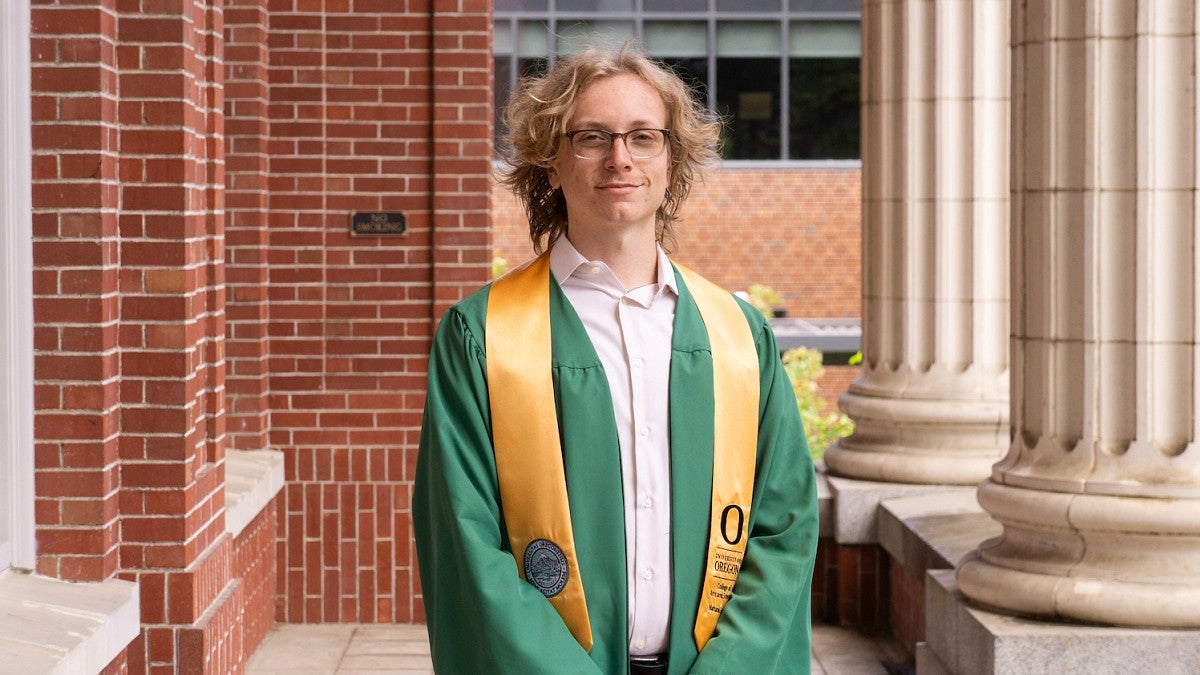
By Evan Ney, Writing Assistant, College of Arts and Sciences
When Noah Weis arrived at the University of Oregon as a first-year computer science major, he wasn’t sure what the future would hold. Fast forward four years: he took a job at a dream company because of the opportunities made available to him through the College of Arts and Sciences School of Computer and Data Sciences (SCDS).
SCDS offers a comprehensive education experience coupled with a strong focus on experiential learning to give students a leg up in terms of career readiness upon graduation. For Weis, that included exciting in-class projects, collaborating with industry partners and getting involved in a student club where he was able to organize a huge event as a student leader.
While all the opportunities Weis pursued wouldn’t work for everyone, his passion for computer science and the work he did while in school, offer a template of success for other Ducks.
Pursuing a passion for computer science
Weis’ initial interest in computer science was broad.
“I developed an interest in computer science from playing video games as a kid, and I spent a lot of time building and tinkering with computers in high school,” Weis said. “It wasn’t until I got to the UO that I started coding more seriously and discovered how much creativity there was in the problem solving it involves. It fascinates me that the first solution you find for a problem is often not the best one.”
He had early access to advanced classes, which exposed him to additional areas of interest, but his passion for the subject exploded when he found a community in the UO Leet Club. Leetcode is an online platform that helps programmers prepare for technical portions of job interviews by practicing different types of coding problems. Leet Club brings students together to explore and practice together.
“I was already doing daily Leetcode questions on my own because I wanted to get better at programming, so when I saw there was a whole club for it, I instantly knew that was the one I wanted to join,” said Weis. “And I had known I wanted to be in student organization leadership since before coming to the UO; access to those opportunities was part of what made the UO attractive for me as a student.”
Weis quickly joined the leadership group, and by his junior year, he got to serve as a key organizer for QuackHacks, an entirely student-run hackathon. For a hackathon, people interested in coding innovation work to bring their ideas to life quickly in a condensed timeframe, such as 24 or 48 hours. Their ideas span areas such as computer programs, apps, machine learning models and games. QuackHacks has grown into one of the largest innovation marathons in the Pacific Northwest.
“I feel like I got the chance to run a startup in an environment where I could make 1,001 mistakes and still learn so many of the skills you need to be a successful professional,” said Weis. “I also learned a lot by being able to organize a 20-person staff at 20 years old, and it’s amazing to think back on how it just started because we wanted to change Leet Club from being a weekly meeting to something larger.”
Transforming from computer science student to professional
Organizing a hackathon wasn’t the only significant project Weis worked on during his time at the UO. As part of a senior capstone class, which is a core part of a computer science major’s degree, he got to work closely with local game studio, Pipeworks. Game development companies are highly protective of their works in progress, so it was significant that students like Weis got the opportunity to contribute to an ongoing project.
During the class, Weis made an impression on Pipeworks staff, so once the capstone class was finished, they invited him to continue collaborating through an independent study. Although this was not a typical outcome of the class, Weis was not a typical student.
“I remember doing the capstone and getting a chance to talk to their director of engineering about what I was doing at the university,” he said. “I was telling him about QuackHacks and a machine learning class where I was building a mini LLM, and they must have liked the work I was doing for them as well.”
After the independent study, Pipeworks extended Weis a summer internship and eventually a full-time position.
“Pipeworks has contributed to some of my all-time favorite games, so when they offered me a summer internship I immediately canceled all my summer plans. I had actually been thinking of going on to do a master’s, but when they told me they wanted to offer me a full-time position as soon as possible, I was actually able to graduate two terms early to get started,” said Weis. “I graduated and started working with them full time the following Monday.”
Weis’ time in SCDS was driven by his remarkable self-direction, but he also credits the support he received during his studies.
“I initially chose the UO because I thought it would be a place where I could get support from the faculty and university. When I applied, I didn’t know I would build something like QuackHacks — I didn’t even know what a hackathon was — but the support from faculty like Hank Childs and Eric Wills made it possible,” said Weis. “It’s exciting that it all panned out pretty much perfectly. It's been a real honor to reflect on all the lessons I learned from my time at the UO, and I’m really excited for what’s next to come.”
Whether he’s building LLMs, organizing major events or programming the next hit video game, the future is surely bright for this SCDS alum.