
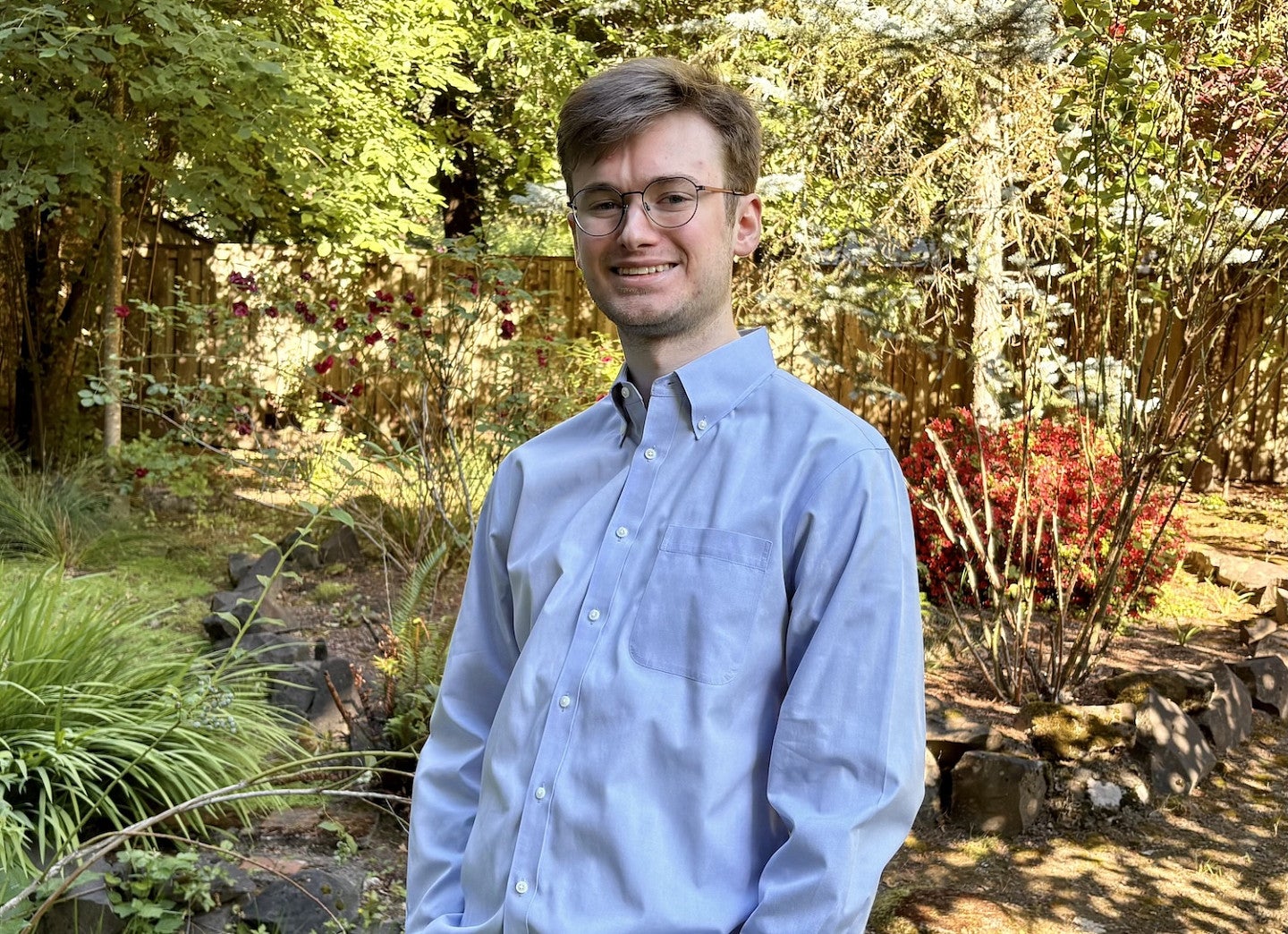
When Hunter Everton BS '25 (sociology), BS '25 (data science) arrived at the University of Oregon, he had little idea where his undergraduate education, let alone his career, would take him. Four years later, he is preparing to begin a master’s degree at Oregon Health and Science University in epidemiology. He plans to pursue a career in research, particularly focusing on public health in rural areas, building on his dual bachelor’s degrees from the College of Arts and Sciences in data science in the School of Computer and Data Sciences and sociology in the Division of Social Sciences.
Although Everton went into college without declaring a major, he had developed a broad interest in both math and history during high school. This inspired him to take classes in a variety of related areas.
“During my first two years at the UO, I was taking sociology classes, and I was taking data science classes, but it wasn’t until I was taking some of the higher-level classes that I started to understand the connections between the two,” Everton says.
Choosing a domain in data science
An important area of data science is finding a domain — or specific field — a student is interested in exploring through data.
“I went into data science thinking that it was just statistics and that was it. I didn't really understand the point of the domain at the beginning,” Everton says. “And I didn’t really know what sociology was at all going into school. I would say I definitely developed more of an understanding of how studying a specific area of data science can help a person tackle important issues the further along I got in my sociology coursework.”
Hunter picked up sociology as his data science domain officially after taking a sociology class on social inequality, and as he took on more advanced projects in both his sociology and data science classes, Everton began noticing ways his two fields could overlap.
“A big moment for me happened when I took a data science class which had an assignment where we practiced web scraping, I began thinking about larger projects I could work on,” Everton says.
Web scraping is a technique that allows data scientists to pull huge amounts of data from a website. The data can include website contents, info on users and more. Particularly as the role of social media grows in cultural and political movements, trends in this data can be of tremendous interest to a sociologist studying social structures and inequalities.
“What I wanted to look into specifically was pulling data from the website 4chan to understand the political impact of these anonymous forums,” he said.
4chan is an anonymous bulletin board for internet discussions.
“Studying the data from 4chan could give me the opportunity to explore how anonymity affects the way people talk about societal issues,” Everton explained. “Maybe it’s giving people the freedom to express frustration with society in a way they wouldn’t feel comfortable doing as themselves, or maybe people are just saying whatever gets shock value. Regardless, there are major social implications at play on these sites that are rife with political content.”
The usefulness of data science skills
Given these post-internet developments in behavior and the rapid evolution of the field of data science, combining sociology with data science is an emerging area of study. And although this project was focused on the mechanics of web scraping rather than formulating a large-scale research project, it helped Everton lay the groundwork for future thinking across disciplines.
“Pretty much all sociologists will at some point use statistical techniques in their research,” Everton says. “But even in the field, combining the social science knowledge and the data science knowledge is still very new, and we're still trying to understand these new data structures that are coming out.”
By the time he graduated, his dual background led Everton into a graduate program that will draw on both his areas of expertise.
“Graduate programs are doing a better job prioritizing data science skills, but it’s getting more complicated with the development of artificial intelligence and the privacy concerns and the social aspects concerning artificial intelligence and machine learning models,” he said.
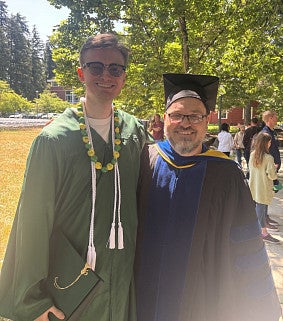
In the broadest sense, his focus on epidemiology allows him to study the relationship between diseases and populations, which brings the opportunity for meaningful impact in research and policy. For Everton, the ability to make this impact, as well as the desire to do so, started largely at the UO, crediting professors like Hannah Waight and Aaron Gullickson for showing him the type of work that can be done in combining these fields.
“It’s a complicated time, especially in data science, but I'm hopeful about a career in public health research,” he said. “I’ve loved research ever since starting my undergraduate degree, and I think that public health is very much geared towards this combination of data science and sociology.”
Everton will continue drawing on his varied background at OHSU to ask big questions and find the data to back up his answers in a hugely important area of society.
— By Evan Ney, College of Arts and Sciences