
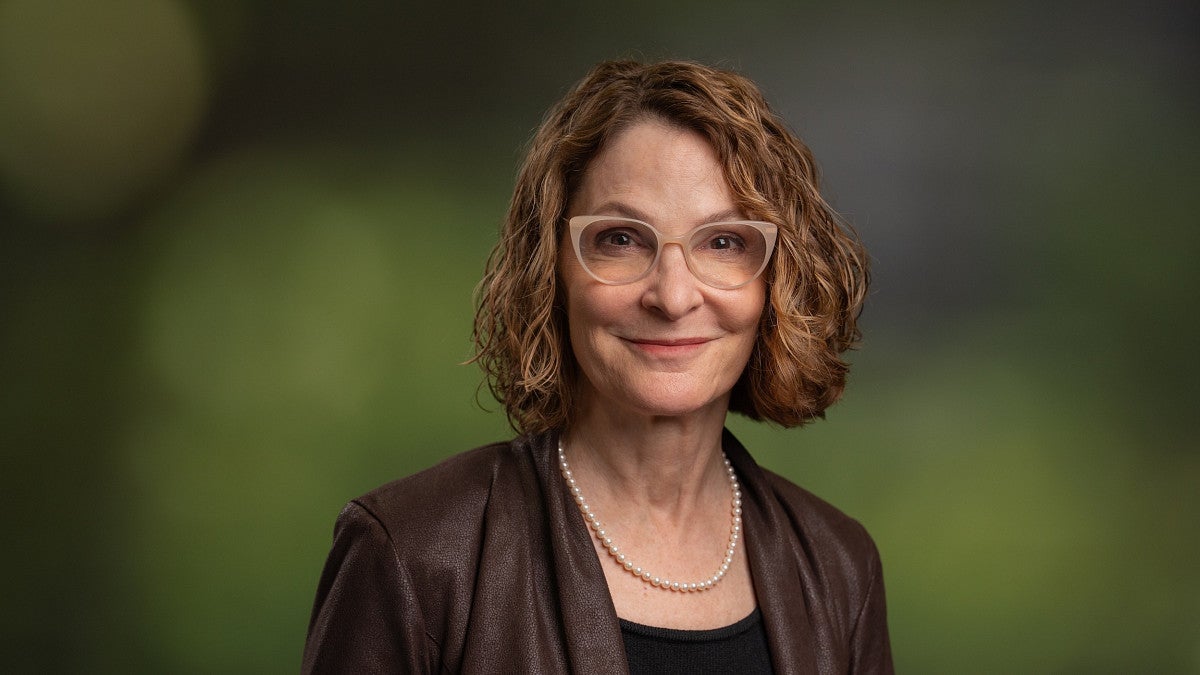
The School of Computer and Data Sciences (SCDS) in the College of Arts and Sciences (CAS) has entered a new era. Beth Plale has taken the helm as its inaugural executive director, bringing with her a distinguished record of research, education and visionary leadership. A seasoned academic, Plale comes to the school with bold ideas to make it the place to be to learn, engage in research and be part of a community.
A distinguished career
Plale was previously at Indiana University Bloomington where she began as an assistant professor in 2001 before earning a distinguished professorship, serving as chairperson of the Department of Intelligent Systems Engineering and the executive director of the Pervasive Technology Institute.
Plale’s research expertise is in AI accountability, policy and governance; data management, open science, provenance and reproducibility, and high-performance computing. She has founded a number of organizations, including community consortia such as the Research Data Alliance and the Collaborations to Enable Transnational Cyberinfrastructure Applications. Plale is a co-principal investigator of the NSF AI Intelligent Cyberinfrastructure for Computation in the Environment Institute funded by the US National Science Foundation.
Over the course of her career, Plale has authored more than 170 peer-reviewed publications and has won tens of millions of dollars in research funding.
A vision for SCDS’s role in the Pacific Northwest and beyond
Plale sees SCDS as uniquely positioned to be a leader at the nexus of AI, high-performance computing, cybersecurity and data-driven societally aware research.
“Drawing on the vibrant technology ecosystem in the ‘Silicon Forest’, SCDS will be recognized nationally and internationally as a leader in AI and technology innovation,” she said.
SCDS’ positioning within CAS keeps the humanities perspective in close range, allowing important diffusion both into the school and throughout the broader college.
Immediate priorities: Growth, research and student success
Plale’s early priorities include growing the school’s research reputation and enrollment, increasing student preparedness and integrating AI into the curriculum in ways that empower — rather than replace — human creativity.
“Students who come to SCDS will be equipped to be successful regardless of what the technology landscape looks like around them,” she says. “We’re interested in how we can facilitate key learning that allows one to be both innovative and creative with these tools. To me, that’s the essence of what a School of Computer and Data Sciences can teach.”
One of Plale’s central philosophies is in supporting students with a wide range of strengths and from varying backgrounds.
“I came from an economic environment where attending college was not my future. I believe talented students come from across the economic and social spectrum so am inclusive in meeting students wherever they’re at and giving them the opportunity that they need to succeed,” she said.
Fostering a community centered around excellence in a wide range of areas related to computer and data science is no small task. Plale says she is up for the challenge and is focused on establishing SCDS as a premier destination for technology education and research in the Pacific Northwest.
— By Evan Ney, College of Arts and Sciences