
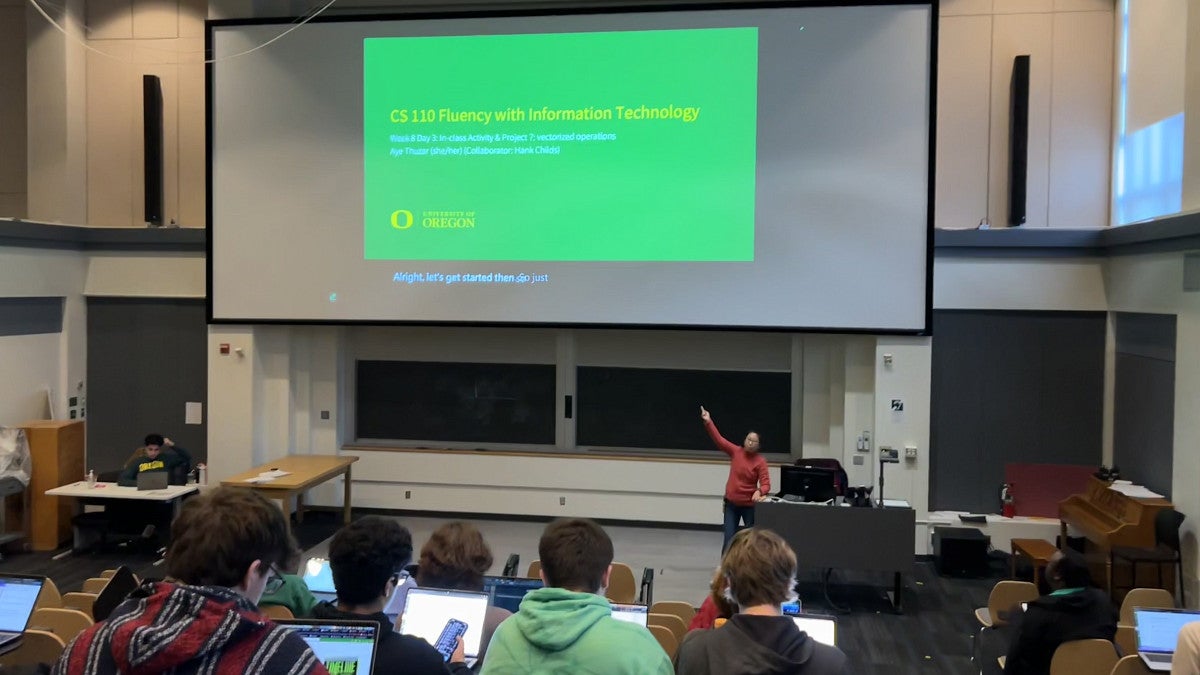
For a typical student in Computer Science 110, working on a project likely involves sitting down with their laptop, opening up an AI model like Gemini or GitHub Copilot, and inputting prompts to help it produce the code for them. Contrary to what might be the case in other classes, this student is not cheating on their assignment. Rather, they are doing exactly what the course encourages them to do.
Over the past few terms, computer science professors Hank Childs and Aye Thuzar have been working on reworking the entry level computer science class, “Fluency with Information Technology,” to incorporate AI-assisted programming. The idea is that allowing AI to take care of smaller details — like accurate syntax — allows students to cover more ground in a single introductory class.
“The course exposes students to basic information like what bits and bytes are, all the way up to what is happening in the field right now with things like AI and cloud computing,” said Thuzar, who taught the class fall 2025. “The class used to just cover HTML and CSS [two types of coding styles], and those are still a part of it, but we’ve expanded it into more of a one-stop course.”
“Even if you never take another class in our department, students in this course get a good sense of the breadth of the computer science field,” she added.
Making AI do the “dirty work”
Over the 10 weeks of the term, students develop a portfolio of projects involving graphics and data manipulation, covering a wide variety of topics like lemmatizing and refactoring – methods of sorting and restructuring code — and developing the ability to read and interpret code, including that produced by AI models.
“Normally, these are topics that are taught in 200-level classes that you wouldn’t have been able to access within three weeks of jumping into a computer science class,” said Thuzar.
Although they’re working on more advanced projects now, many of the students taking the class had never coded before in their life.
“The first week of school, I didn’t even know how to create a file for my assignments — one of the reasons I took this class is because I knew technology was important but had no idea how to use my laptop. Now I have a pretty good understanding of the code we’re going over in class,” said Billy Jackson ’29, who is at the UO to study accounting.
Understanding code is one of the central ideas behind the course. Even if students aren’t writing all the code themselves, they are still in charge when it comes to evaluating what AI produces for them.
“You want AI to do the ‘dirty work’ for you. You don’t want AI to actually take over your work and decide what you need to do,” said Thuzar.
Class sessions frequently involve group work and activities that use a much older technology than AI: pencil and paper. While some students complete their work with a laptop open, most huddle around desks to work without outside assistance.
Embracing AI in the right context
In fact, much of the course is completely accessible to students even without the use of AI. Since the class counts towards several types of degree requirements, some of the students who end up in the class come in with strong opposition to using AI.
“I am still pretty anti-AI, but I think I have a more nuanced perspective,” said Wafiya Hasan ’28, who is interested in the creative side of advertising and sustainable business. “In creative fields I think it can be harmful, and I have concerns about things like its environmental impact, but I also understand its uses and benefits in fields such as computer science."
Added Giulia Nossa ’29, a human physiology major, “I think it’s important how you use it. I’d rather use AI to explain how to do something than to actually do it — that’s mostly how I’m using it in this class.”
Developing an individual’s sense of how the tools presented in class might be useful in the future, regardless of a student’s field of study, is another important aspect of the course. In previous iterations of the class, non-computer science majors have gone on to take more computer science classes, but many haven’t. One of the goals of revamping the course was to make its material more useful to these non-computer science majors.
“We have designed the course so that the tools we are using will continue to be available to them. If they use Google Docs, they can continue doing what we’ve been working on. They can use a laptop, or an iPad, or whatever they have,” said Thuzar. “If this is the only computer science class they ever take, they can still use what they’ve learned to go do things and work on exciting projects.”
— By Evan Ney, College of Arts and Sciences