
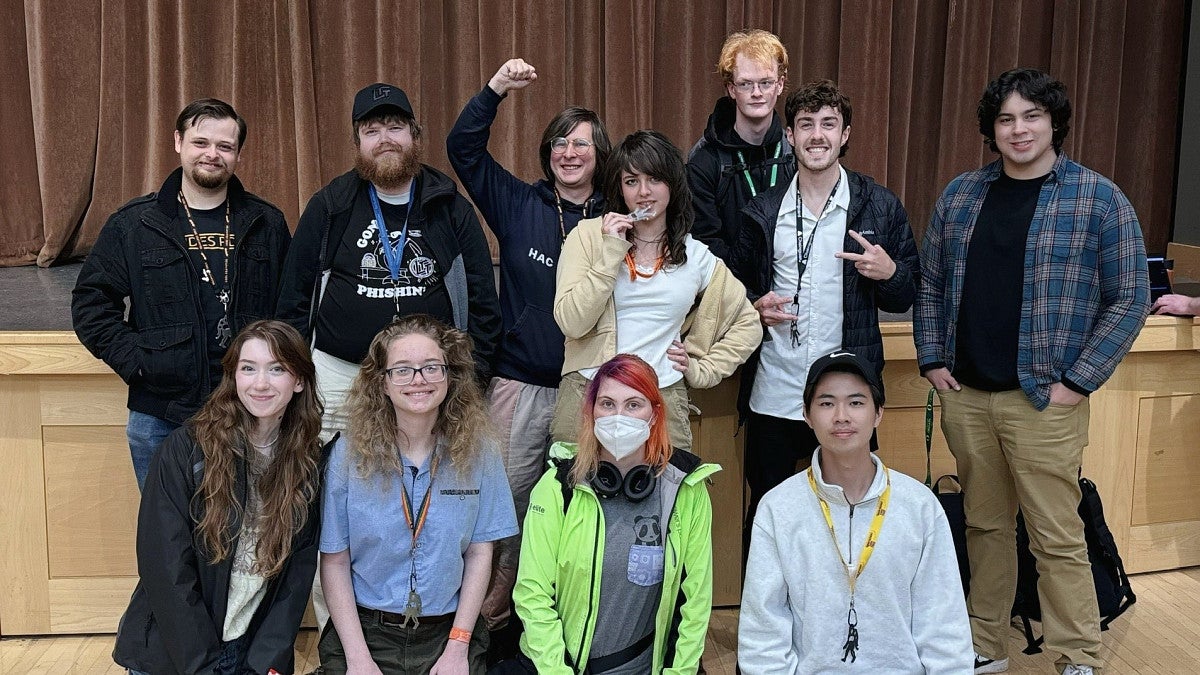
With just minutes remaining in the regional cybersecurity competition, the Cyber Ducks were neck and neck with their opponents. Making it to that point was already an impressive feat, but when the team of students beat the team of professionals, the looks of pride on the Cyber Ducks' faces were unmistakable.
Each year, the members of Cyber Ducks, University of Oregon’s Cybersecurity Club, travels to BSidesPDX, an annual cybersecurity conference. Students attend panels, participate in events and activities, network with others in the field, and compete in the big competition.
This year, dozens of teams from across the Pacific Northwest participated in the two-day competition. Teams were tasked with racing to complete challenges across several categories, each with varying levels of difficulty; the harder the challenge, the more points it was worth. The Cyber Ducks focused mainly on challenges in categories like web exploitation, open-source intelligence, binary exploitation, reverse engineering, cryptography and lockpicking. Their competence across many areas was key to their success.
Events and panels at BSidesPDX covered a wide range of topics, with students learning about things like the role of AI in hacking, email server security and how security professionals can support domestic violence survivors.
Thanks to the club, students were able to attend for free. The club funded attendees’ registration fee, transportation, food and hotel costs. And because of their win, the club can offer more experiences to its members going forward. As a prize, the club was given a choice between several rewards, and they chose a handful of resources related to lockpicking, including a fully customizable high-quality lock with a selection of pins and drivers to insert, a new lockpicking set and a book on lockpicking. While lockpicking is an analog activity, it’s a core principle in cybersecurity, serving as a reminder that there are ethical and legal considerations when it comes to breaking a secured system.
Getting to spend time doing shared hobbies like lockpicking, in addition to their technical studies, can pay dividends, especially in competitive situations.
“We’ve been working all year to encourage club members to collaborate and get to know each other. So when the competition came around, it was really rewarding to see how well our team already knew how to work together, both socially and technically. Everyone brought something different to the table,” said Esmé Nadeau ’26 (computer science), club president. “Seeing all those different strengths come together as a team was one of the best parts of the experience for me.”
— By Evan Ney, College of Arts and Sciences